New Political Theories and Ideas
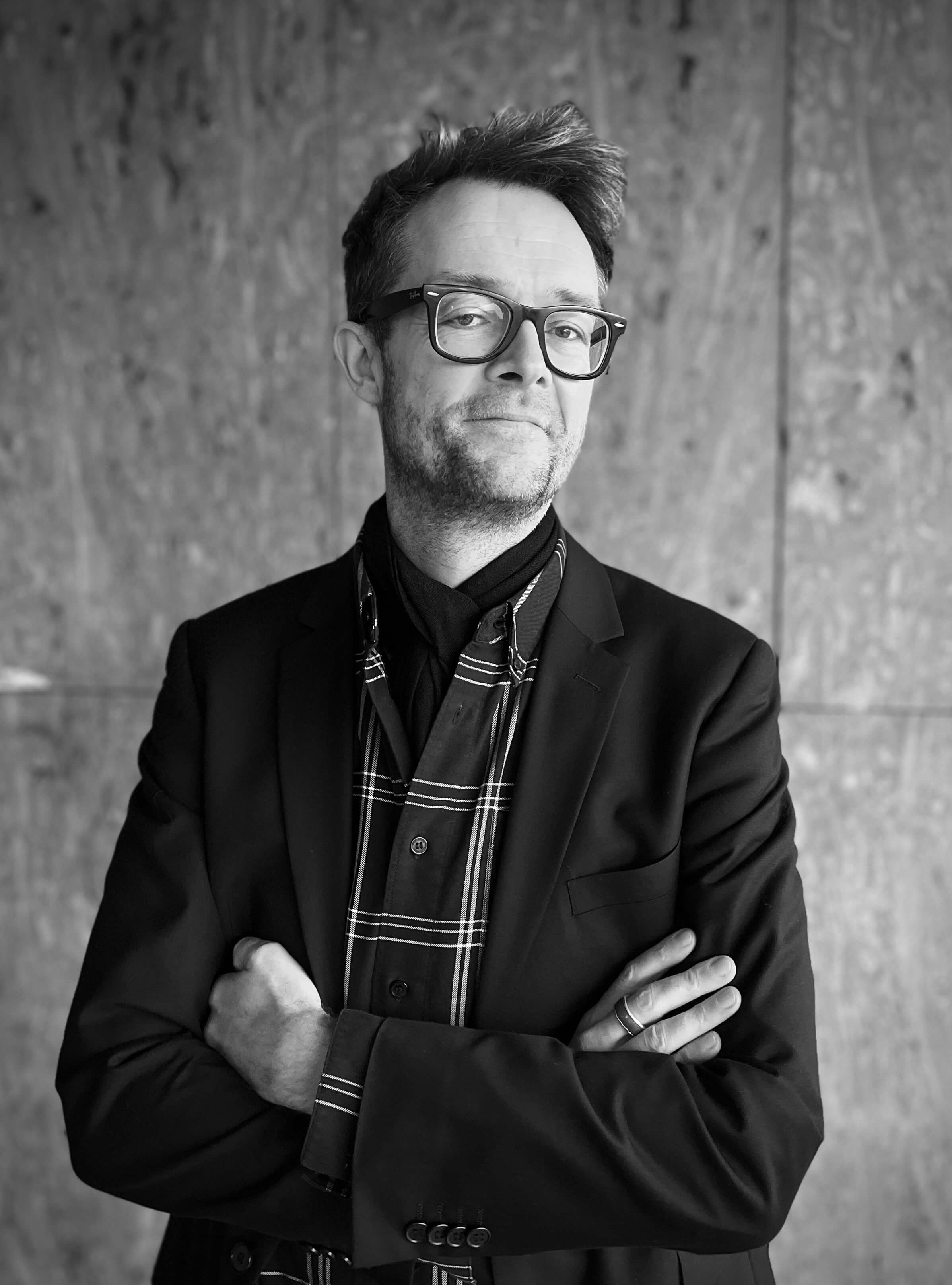
PD Dr. Veith Selk is a political and social scientist. His research focuses on democratic theory, the history of political thought, populism, political ecology, and conflicts arising from sociotechnical change.
He was a visiting professor and deputy director of the Institute for Social Change and Sustainability at the Vienna University of Economics and Business. As part of the Hessian research network “Challenges of Democracy in Times of Regression,” he addressed issues in democracy research. He currently holds the Chair of Political Science at the University of Vechta (interim position).
In addition to his academic work, he is active in civic education and citizen science. He lives in Hamburg.
Upcoming Events
As part of the Frankfurt Book Fair and in cooperation with Suhrkamp. Location: Dondorf Druckerei in Bockenheim. Julian Nicolai Hofmann and Veith Selk in conversation with Catherine Newmark (freelance journalist) and Ricarda Lang (Member of the German Bundestag for Bündnis 90/DIE GRÜNEN)
Current Books
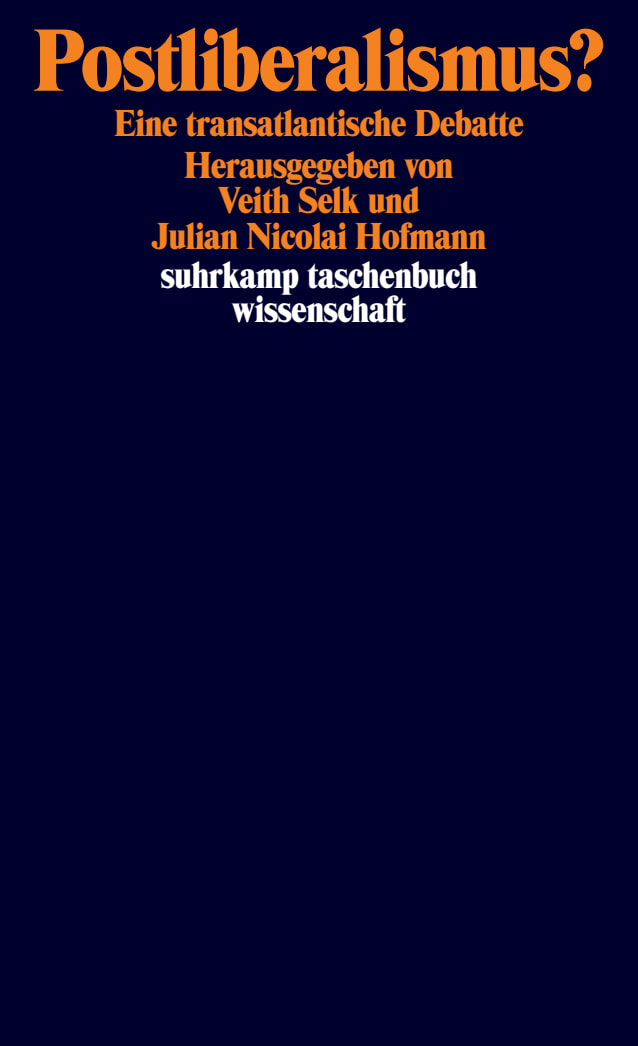
Postliberalismus?
A Transatlantic Debate
The hegemony of liberalism appears to be coming to an end. In light of intensifying geopolitical crises and the accelerating erosion of liberal democracies, alternatives to liberalism are being discussed on both sides of the Atlantic, grouped under the ambigous term of post-liberalism. The volume brings together contributions from internationally renowned scholars including Thomas Biebricher, Annelien de Dijn, Patrick J. Deneen, Anton Jäger, Philip Manow, Samuel Moyn, Jan-Werner Müller, Elif Özmen, Adrian Pabst, and Nadia Urbinati, who examine this new phenomenon. As observers, critics, or advocates of such alternatives, they ask: Can liberalism still be saved?
Reviews
- Was die Linke vom Postliberalismus lernen kann Review by Julia Werthmann in FREITAG
- Muss man Postliberalismus ernst nehmen Review by Nils Schniederjann in ANDRUCK / Deutschlandfunk
- Vorwärts in die Vergangenheit? Review by Stefan Reinecke in TAZ
- Rückkehr zu Familie, Nation und starkem Staat Review by Herfried Münkler in Frankfurter Allgemeine Tageszeitung
- Tugend ist keine Privatangelegenheit Review by Sascha Vetterle in DIE TAGESPOST
- Der Postliberalismus erhebt sein Haupt, wo der Liberalismus scheitert Review by Jakob Hayner in DIE WELT
- Postliberalismus: Zeitdiagnostisch oder rückwärtsgewandt? Review by Lina Paulitsch in DER FALTER
In the Media
- Sind Postliberale einfach verunsicherte Liberale? Jonas Junack in Jacobin
- Sie wollen den Liberalismus überwinden Till Schwarze-Thurm in DIE ZEIT
- Was kommt nach dem Liberalismus? Julian Nicolai Hofmann and Veith Selk in conversation with David Kirchner for PORTAL FÜR POLITIKWISSENSCHAFT
- Postliberalismusdebatte: Macht Liberalismus einsam? After the “vibe shift” comes post-liberalism: A new political theory explains the upheavals of our time. DIE ZEIT podcast with Ijoma Mangold and Lars Weisbrod
- Versprechen ohne Glanz: Was folgt auf den Liberalismus? Veith Selk in conversation with Wolfram Eilenberger for “Sein und Streit” / Deutschlandfunk Kultur
- Sind wir jetzt alle Postliberale? Für einen liberalen Postliberalismus Carlotta Voß in "Schriftenreihe Vordenker der liberalen Moderne"
- Linker Postliberalismus: Deutschland, aber sozial? Ole Nymoen and Wolfgang M. Schmitt in WOHLSTAND FÜR ALLE
- Krise der liberalen Demokratie: Gibt es jetzt eine Alternative zum Liberalismus? Julian Nicolai Hofmann reviews three books on post-liberalism for FRANKFURTER ALLGEMEINE ZEITUNG
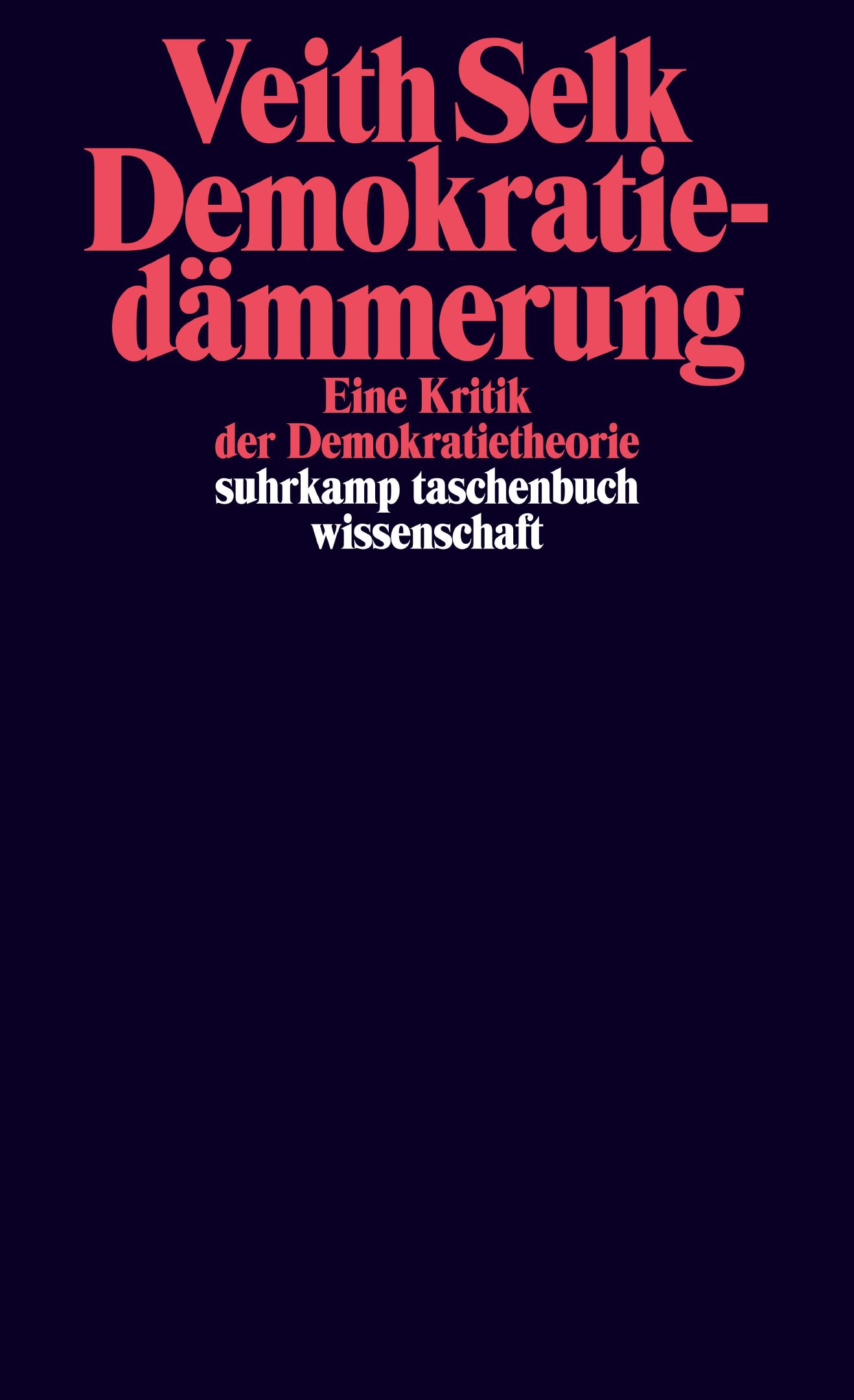
Demokratiedämmerung
A Critique of Democratic Theory (October 2023)
»Maybe a good idea in theory, but unfortunately fails in practice«
What was once said about communism now applies to democracy — it is becoming increasingly implausible.
In his sharply analytical book, Veith Selk shows why both democratic politics and the democratic theories that accompany it are failing in the face of reality.
Two theses are pursued: The decline of democracy is not due to regression but is the result of social evolution. The resulting end of democracy also leads to the decay of democratic theory, which is becoming anachronistic as an academic discipline. (Text: Suhrkamp)
Reviews
- Review in ZEIT by Thomas Assheuer
- Review in REPUBLIK by Daniel Binswanger
- Review in FAZ by Christoph Möllers
- Review in FALTER 6/24 by Robert Misik
- Review at politischebildung.at by Tamara Ehs
- Review in Psychologie-Magazin
- Review by Frithard Scholz
- Review at soziopolis by Dagmar Comtesse
- Review at Ethik & Gesellschaft by Moritz Fromm
- Review at Theorieblog.de by Reinhard Mehring
- Review at Wissenschaftsdebatte.de by Wolfgang Goede
- Review in Jahrbuch Extremismus & Demokratie (36), 473-475 by Isabelle-Christine Panreck
- Review in Politik & Ökonomie by Matthias Ubl
- Review at kritisch-lesen.de by Thore Freitag
- Review at Francia Recensio by Werner Bührer
- Review in Merz. Zeitschrift für Medienpädagogik by Daniel Aberl
- Review for GWP Gesellschaft. Wirtschaft. Politik by Manfred G. Schmidt
- Review for pro Zukunft by Josef Hörmandinger
- Review for ifz. Wissenschaft für Menschen by Birgit Bahtic-Kunrath
In the Media
- Interview in ND with Alex Struwe
- Interview WDR5/Politikum
- Conversation at Kreisky Forum Vienna with Robert Misik
- Conversation at TAZ Talk with Aaron Gebler
- Interview at SEIN UND STREIT with Stephanie Rohde
- Discussion at DIE NEUEN ZWANZIGER by Stefan Schulz & Wolfgang M. Schmitt
- Essay in DIE ZEIT by Lenz Jacobsen
- Book review at SCOBEL
- Guest essay for NEW YORK TIMES
- Podcast "Democracy in Danger?" by Federal Agency for Civic Education